November 19, 20260 views
Holiday Gift Boxes From Your Texas Home Kitchen: Packaging, Labels and Delivery
How to plan a short holiday gift box lineup, package and label it under Texas cottage food rules, and handle online orders with personal delivery.
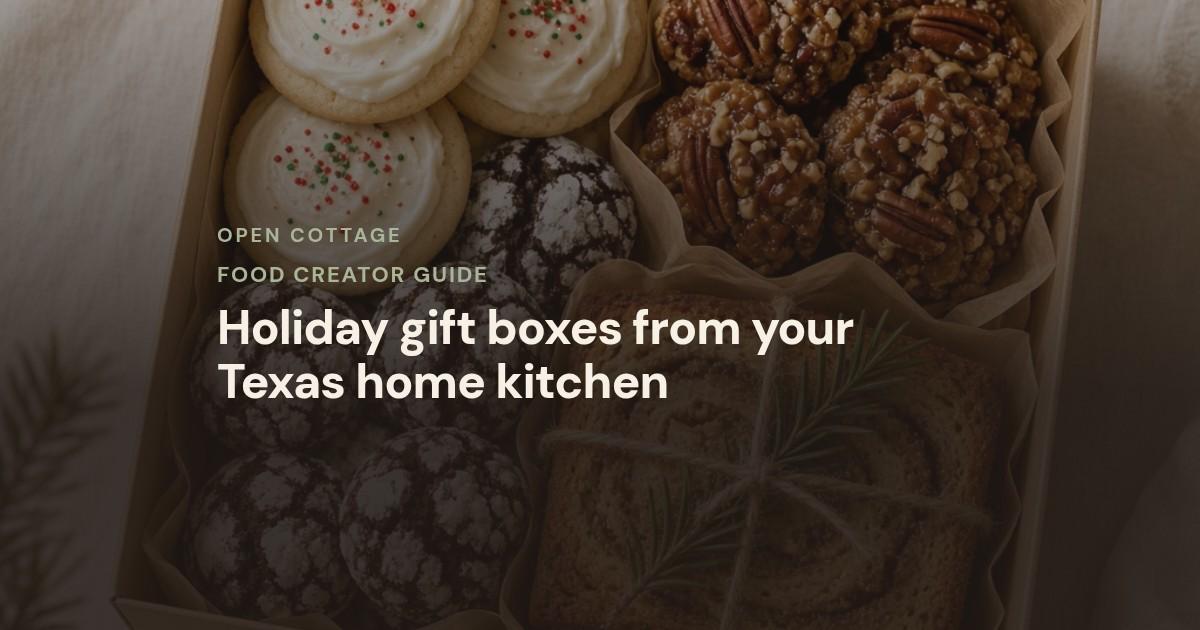
Holiday gift boxes are one of the easiest things to pre-sell from a home kitchen. People are already shopping for teachers, coworkers, neighbors and clients, and a box of homemade treats beats another gift card. This guide covers how to plan a small gift box lineup, how to package and label it under Texas cottage food rules, and how to handle online orders and delivery.
This is general information, not legal advice. Rules can change, so check the official Texas Department of State Health Services (DSHS) pages linked below before you sell.
Plan a short lineup
A short menu sells faster than a long one. Buyers decide quickly when the choice is simple.
- Offer two or three sizes. A small "thank-you" box, a medium "share with the office" box and a large "family" box covers most gift budgets.
- Choose items that hold up. Pick treats that still taste great a few days after you make them, since many boxes get handed off later as gifts.
- Show one clear photo per box, with what's inside and the price.
- Set a cutoff and a handoff day. Pick the last day you'll take orders and the day or days you'll deliver or hand off boxes, so you can plan baking and shopping in batches.
If you're new to pre-orders, our guide to running Thanksgiving pre-orders from your home kitchen walks through order caps, upfront payment and handoff windows, and the same approach works for December. For setting prices, see how to price your homemade food.
Package it so it stays clean
Texas DSHS says foods sold by a cottage food production operation must be packaged and labeled, and packaged in a way that prevents product contamination. The exception is food that is too large or bulky for conventional packaging; in that case, the labeling information goes on an invoice or receipt (Texas DSHS cottage food page).
For gift boxes, that usually means wrapping or sealing items inside the box rather than loose treats on tissue paper:
- Sealed cellophane or food-safe bags for cookies and candy
- Lidded tins for cookies and brittle
- Closed bakery boxes for breads and cakes
Label every product
The same DSHS page lists what a Texas cottage food label must include:
- Legible writing
- The name of the cottage food production operation
- The address of the operation, or the unique identification number DSHS gives you when you register, in place of the address
- The common or usual name of the product
- Any major food allergen the food is made with, such as eggs, tree nuts, soy, peanuts, milk, wheat and sesame
- The disclosure: "THIS PRODUCT WAS PRODUCED IN A PRIVATE RESIDENCE THAT IS NOT SUBJECT TO GOVERNMENTAL LICENSING OR INSPECTION."
If you'd rather not print your home address on every gift box, DSHS lets operators register on the DSHS Online Licensing Registry and put their registration number on the label instead.
A few extra rules apply to some foods. Foods that need time and temperature control for safety (TCS) require registration, the date the food was made on the label, and a safe handling statement. Pickled, fermented and acidified canned goods need a batch number. Check the DSHS page if any item in your box falls into those groups. For a printable walkthrough, see our Texas cottage food label checklist.
Gift box tip: if a box holds several different products, label each product, not just the outside of the box. The person who opens the gift may not be the person who ordered it, and they still need to see the allergens.
Selling online? Plan your delivery
Holiday orders often come in by message or online form. DSHS says cottage food may be sold online when:
- The consumer bought the food online from the operator.
- The operator, an employee or a household member personally delivers the food to the consumer.
- Before taking payment, the operator posts all the required labeling information as a legible statement on the operation's website.
After payment, the operator's address or unique identification number must be on the food's label (Texas DSHS).
In practice, that means planning delivery routes or pickup windows, not shipping boxes across the state. Group deliveries by neighborhood and give buyers a time window to keep your days manageable. Our guide on where you can sell cottage food in Texas covers the other ways to sell, including direct sales, samples and wholesale.
Food handler card
If you run a cottage food operation in Texas, DSHS also requires an accredited food handler course. Our food handler card guide explains who needs one and where to get it.
Give your holiday menu one home
Gift box orders get messy when your menu lives in five different places. At launch, Open Cottage will give food creators one free page for your menu, photos and how to order, so you can share a single link. Home cooks, food trucks and licensed cottage kitchens are all welcome.
Reserve your name free at opencottage.com
Sources
- Texas DSHS: Texas Cottage Food Production (packaging, labeling, registration, online sales and delivery; checked Nov 17, 2026)