November 8, 2026
Texas Cottage Food Label Checklist: What Your Label Needs
Selling homemade food under Texas cottage food law? Here's what Texas DSHS says your label needs, from the required disclosure to extra rules for TCS, pickled and fermented foods.
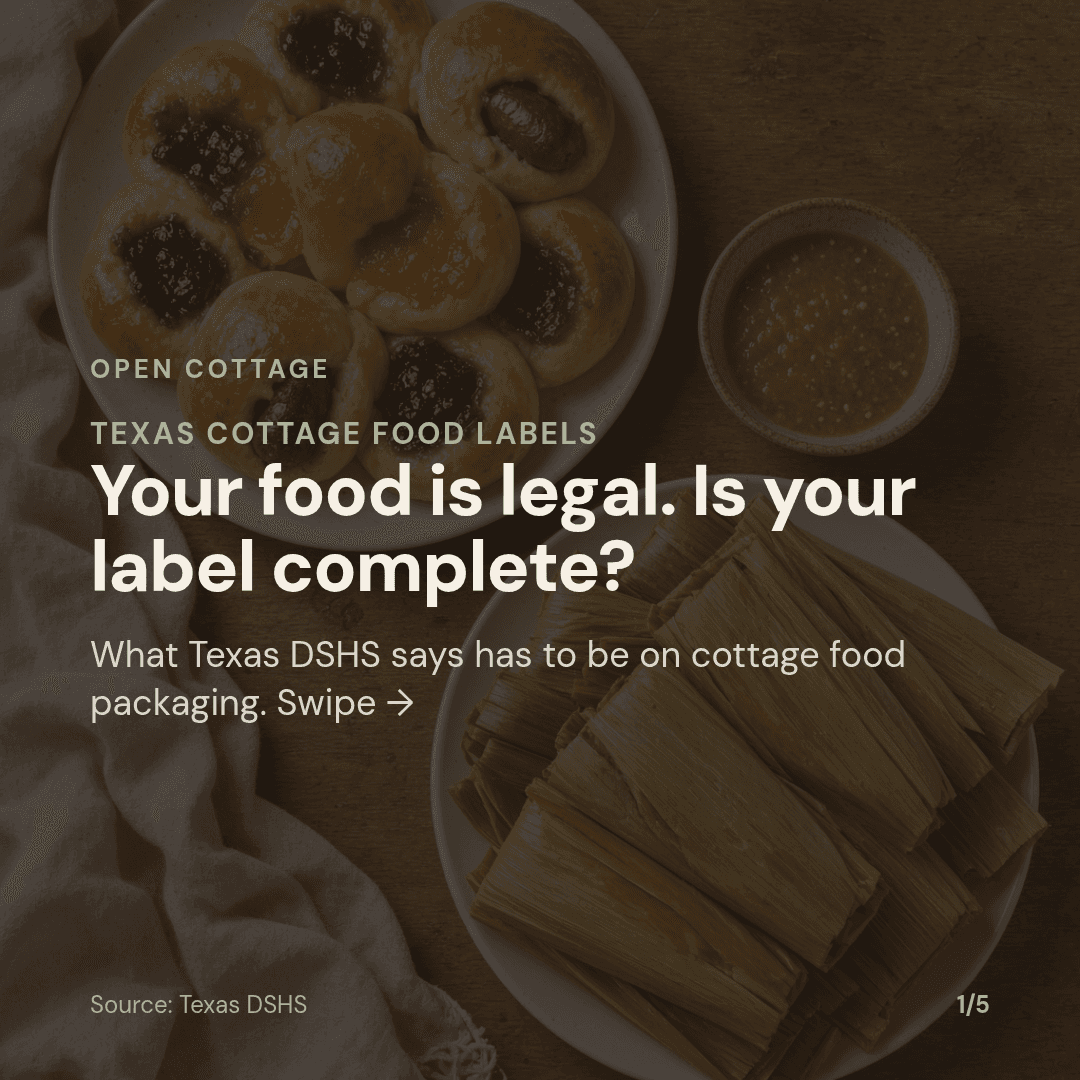
If you sell homemade food under Texas cottage food law, your recipe and your label are both part of what makes the sale legal. This guide is for Texas sellers. Rules vary by state, so if you sell somewhere else, check that state's requirements.
Texas updated its cottage food law with SB 541, which took effect September 1, 2025. It expanded which foods can be sold and changed some labeling rules. Here is what the Texas Department of State Health Services (DSHS) says belongs on a cottage food label.
1. The basics
Every cottage food label must be legible and include:
- The name of your cottage food production operation.
- Your address, or your DSHS registration number in its place. Under SB 541, you can register on the DSHS Online Licensing Registry and print the registration number you receive instead of your home address. Many home-based sellers prefer that for privacy.
- The common or usual name of the product, such as "sourdough bread" or "pecan pralines."
2. Major allergens
If a food is made with a major food allergen, that ingredient must be listed on the label. DSHS names eggs, tree nuts, soy, peanuts, milk, wheat and sesame as examples. Practical tip: keep an ingredient sheet for each product so your labels stay accurate when a recipe changes.
3. The required disclosure
Your label must include this statement:
THIS PRODUCT WAS PRODUCED IN A PRIVATE RESIDENCE THAT IS NOT SUBJECT TO GOVERNMENTAL LICENSING OR INSPECTION.
Copy the wording exactly. It tells customers how the food was made, and it is one of the most commonly missed items on homemade labels.
4. Extra rules for some foods
Time and temperature control for safety (TCS) foods. These are foods that need refrigeration or temperature control to stay safe. Sellers of TCS foods must register with DSHS and:
- put the date the food was made on the label, and
- include this statement, in at least 12-point type, on the label or on an invoice or receipt provided with the food: "SAFE HANDLING INSTRUCTIONS: To prevent illness from bacteria, keep this food refrigerated or frozen until the food is prepared for consumption."
DSHS also says TCS foods must be stored and delivered at temperatures that keep cold items at 41°F or below and hot items at 135°F or above. TCS foods can't be donated or sold wholesale to cottage food vendors.
Pickled, fermented and acidified foods. Each batch of pickled fruit or vegetables, fermented vegetable products, or plant-based acidified canned goods needs a unique batch number on the label. DSHS also lists approved recipe sources for these foods.
5. Bulky items, online sales and vendors
- Too large or bulky to package? Foods normally must be packaged to prevent contamination. If an item is too large or bulky for conventional packaging, give the customer the label information on an invoice or receipt.
- Selling online? Before you accept payment, post all the required labeling information as a legible statement on your website. After payment, the label on the food must show your address or registration number. The food must be personally delivered by you, an employee or a household member.
- Selling through a cottage food vendor? Food sold by a registered cottage food vendor must have the date it was made on the label.
Before you print
Texas law also requires cottage food operators to complete an accredited food handler training program, and some foods can't be sold as cottage foods at all, such as meat, poultry, seafood, ice cream and other frozen ice products, low-acid canned goods, raw milk, and products containing CBD or THC.
This post is a general summary, not legal advice. Rules can change, so always check the current Texas DSHS cottage food guidance and Texas Health and Safety Code Chapter 437 before you print labels. Questions can go to DSHS at foodestablishments@dshs.texas.gov.
Get your menu found
A correct label builds trust. So does being easy to find. Open Cottage is building a free directory where food creators and food trucks can share their menu, photos and how to order in one place. Sign-ups are open to food creators across the U.S. Reserve your name free at opencottage.net.
This guide expands on our Sunday label-checklist carousel. See it on Instagram and Threads.