November 28, 20260 views
5 Myths About Selling Food From Your Texas Home Kitchen (and What the Law Actually Says)
Thinking about selling food from your Texas home kitchen in 2027? Five common cottage food myths, from city permits to the $50,000 cap, checked against Texas DSHS and SB 541, plus registration, online sales, training and a pre-launch checklist.
If you've been thinking about selling food from your Texas home kitchen in 2027, you've probably heard advice that was true a few years ago, or was never true at all. Texas rewrote a big part of its cottage food law with Senate Bill 541, which took effect September 1, 2025. Here are five myths we still hear all the time, what the law actually says now, and a few extra details that are easy to miss.
Everything below comes from the Texas DSHS Cottage Food Production page and the enrolled text of SB 541. It's general information, not legal advice. When in doubt, check with DSHS directly.
Myth 1: "I need a city permit to start"
Fact: Local public health entities, which DSHS says includes municipalities, counties and public health districts, may not require a cottage food production operation to get any license or permit, or to pay a fee, to produce food or sell it directly to a consumer or a cottage food vendor. They also can't regulate the production of food at a cottage food operation or inspect it.
That doesn't mean nobody is watching. DSHS notes that the state or a local health authority can still act through emergency orders and recalls to prevent an immediate and serious threat to health, and health departments must keep records of all complaints against a cottage food operation.
When you do register with DSHS
Registration on the DSHS Online Licensing Registry is required in three situations:
- You sell time and temperature control for safety (TCS) foods, the ones that need the fridge.
- You'd like to put a DSHS ID number on your label instead of your home address.
- You're a cottage food vendor who buys from cottage food operations and resells to consumers.
If none of those apply, there's no state registration step.
Myth 2: "It's just cookies and jam"
Fact: Under SB 541, cottage food can be almost any food except:
- meat, meat products, poultry or poultry products
- seafood, fish, shellfish and their products
- ice and ice products, including shaved ice, ice cream, frozen custard, popsicles and gelato
- low-acid canned goods
- products containing CBD or THC
- raw milk and raw milk products
That opens the door to a lot of foods that used to be off-limits, including fridge foods like cheesecake, cream pies and tres leches. Those TCS foods come with extra rules: you must register with DSHS, keep them at 41°F or below (cold) or 135°F or above (hot) while storing and delivering, label the date the food was made, and include the safe-handling statement DSHS spells out. We break those down in our guide to selling TCS foods from a Texas cottage kitchen.
Bean and cheese tamales? Possible. Brisket? That's food truck or restaurant territory.
Myth 3: "There's a $50,000 cap"
Fact: SB 541 raised the annual gross income limit for a cottage food production operation from $50,000 to $150,000, and the bill says DSHS adjusts it each year for inflation using the Consumer Price Index (CPI-U).
SB 541 also widened who can operate: the definition now includes nonprofit organizations, and an operation can run from the home of an individual or of a director or officer of the nonprofit.
Myth 4: "I can't sell online"
Fact: You can take orders online. The rules are about how the food reaches the customer:
- The customer buys the food online from you.
- You, an employee or a household member personally delivers it. SB 541 removed "mail order" from the law, so shipping isn't the model here.
- Before you accept payment, the labeling information required by the rules is posted on your website so the buyer can see it.
- After payment, your address or DSHS ID number goes on the food label.
In practice that means your order page (or wherever you take orders) should show each item's label details, and you should plan delivery or pickup hand-offs, not a shipping box.
Myth 5: "No training needed"
Fact: Anyone who operates a cottage food production operation must complete a basic food safety education or training program for food handlers accredited under Texas Health and Safety Code Chapter 438, Subchapter D. DSHS keeps the list of accredited food handler training programs. Our food handler card guide covers who needs one and how to get it.
Bonus facts that surprise people
- Samples are allowed anywhere. DSHS says cottage food operations may provide samples at any location.
- Donations are allowed, except TCS foods. Fridge foods can't be donated.
- You can sell through stores and markets, with a partner. A registered cottage food vendor can buy non-TCS cottage foods from you at wholesale and sell them directly to consumers at a farmers' market, farm stand, food service establishment or retail store. They must post a sign stating the product was "produced in a private residence that is not subject to governmental licensing or inspection," and the label must show the date the food was made. TCS foods can't be wholesaled. More in our guide to where you can sell cottage food in Texas.
- Labels still matter. Every package needs your operation's name, your address or DSHS ID number, the common name of the food, any major food allergens, and the private-residence disclosure. Pickled, fermented and plant-based acidified canned goods also need a batch number. See our label checklist.
What about food trucks?
Food trucks aren't cottage food operations. Since July 1, 2026, Texas mobile food vendors get a statewide license through DSHS instead. See the DSHS Mobile Food Vendors page and our post on the new state food truck license.
A quick pre-launch checklist for 2027
- Pick your menu and check each item against the excluded-foods list above.
- Decide whether anything needs the fridge. If so, register with DSHS and plan your temperature control.
- Finish an accredited food handler course.
- Design your label with every required line.
- Decide how customers will order and how you'll hand off the food.
- Put your menu, photos and how to order in one place customers can find.
Where Open Cottage fits
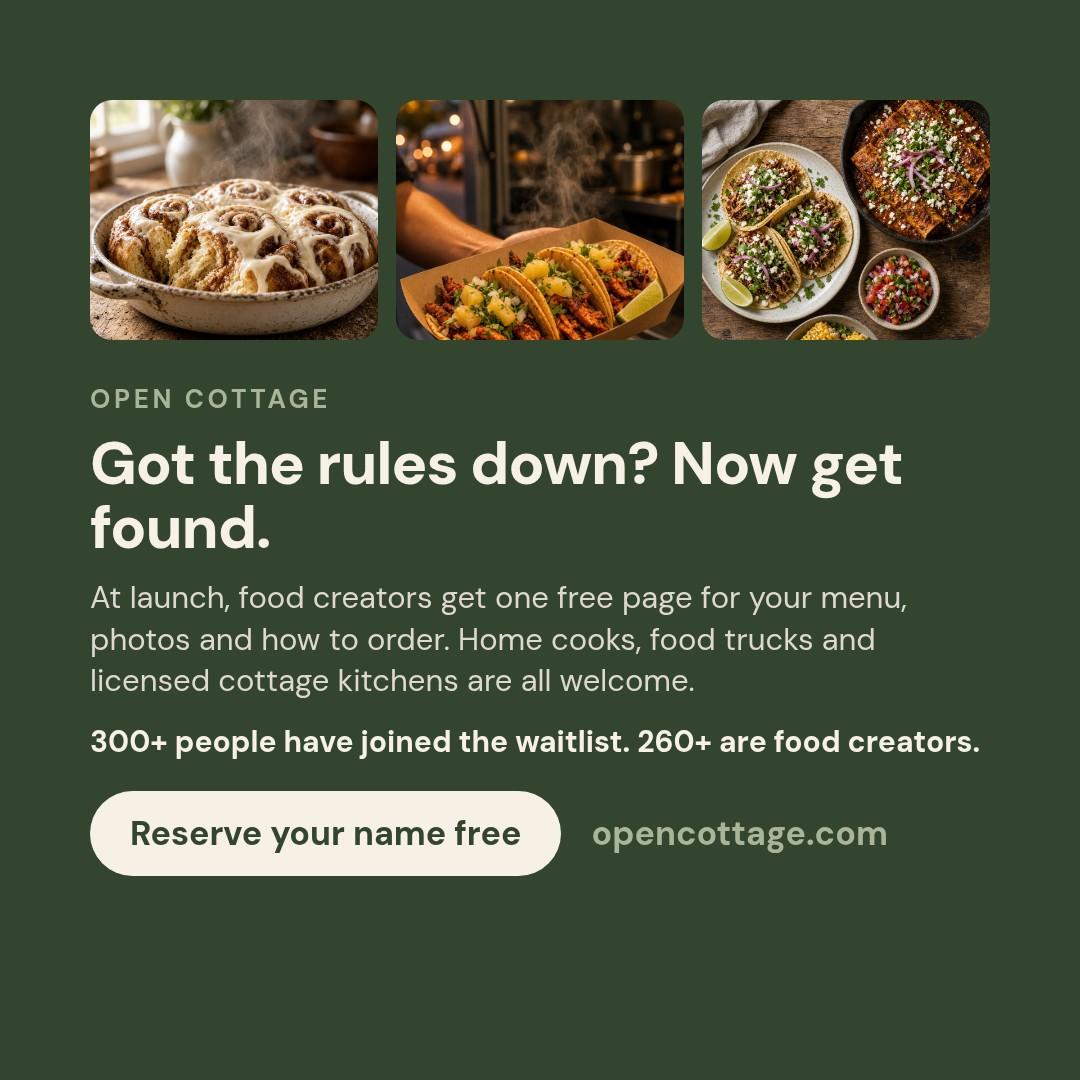
Step 6 is where most home food businesses get stuck: the menu lives in a DM thread, an old post and a flyer. Open Cottage is building one food-only place where people can find homemade food from local food creators. At launch, food creators get one free page for their menu, photos and how to order. Home cooks, food trucks and licensed cottage kitchens are all welcome, and sign-ups are open nationwide. Reserve your name free at opencottage.com.
Sources
- Texas DSHS, Texas Cottage Food Production
- Texas Legislature, SB 541 (89th Legislature), enrolled bill text and bill history
- Texas DSHS, Licensing Food Handler Training Programs
- Texas DSHS, Mobile Food Vendors